School Days
Thoughts on the Odd and Magnificent Art McClaskey

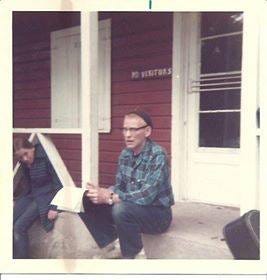
I spent three years (grades 10-12) at an alternative high school in Montclair, NJ. It was an enormously influential experience for me. The guiding light of this alternative high school, an art teacher (and brilliant fellow) named Art McClaskey, died in 2006. I wrote a letter to the Montclair Times about McClaskey (at his insistence, we called him “McClaskey”), and then a longer essay (this essay) which I sent around to some friends and some students. At the time, I had an idea that I ought to pass his story along.
McClaskey insisted that we would find our way by pursuing interesting questions; questions that meant something to us. McClaskey was determined to help each student to find their voice. Much of what I know about teaching, I learned from McClaskey and his amazing Team School colleagues
The Team School and McClaskey changed my life. My three years at the Team School were in many ways the most engaging and most inspiring period of my life. That says a lot -- my life has been full of wonderful, inspiring characters and experiences. McClaskey persuaded me – and many others – that we were capable of more than we imagined, and he encouraged us to have the nerve to try new things, rather than playing it safe. Most and best of all, he made it very clear that it was OK to be ourselves, however odd that might be. We thought of ourselves as odd, and McClaskey helped us to see that as a gift. McClaskey was a remarkable guy in many ways, and he -- by his words and by his example -- inspired many of us to make good (and sometimes “odd”) decisions that we otherwise might not have had the nerve to make.
For years, I’d intended to send McClaskey a note to let him know what he had meant to me, but I never did. I’m sorry about that, and I am sorry that he is gone. But mostly I feel grateful for all that he did for me, and I am happy for him that his life mattered so much. Katherine (my wife), my beloved brother (Carl, who is known to some of you), and some of my dearest friends were students of McClaskey’s as well, so I know that he affected profoundly the lives of a lot of good people.
McClaskey was an odd guy in his own right. He had a buzz cut when no one had a buzz cut (his hair was completely gray from a youngish age – he was in his mid-50s when I knew him). He wore sturdy brown shoes and glasses that might have been stylish 20 years earlier. And he had no driver’s license. He was open to alternative approaches, but impatient with bullshit. He claimed to be a libertarian, but he was disdainful of choices that were made without regard to their broader consequences. He was demanding, but he also conveyed a sense that he loved being around us. And, perhaps more than anything, he demanded that each of us struggle to find our voice. He would often call us “freaks” (as in “Where did all of you freaks come from?”). I get a rush of emotion as I write these words -- it was, it seems to me, his way of asserting that no one of us was a conventional kid.
And we weren’t. The Team School was a wonderful mix: some overly-responsible, independent-thinking, radical kids; some creative, under-achieving wise-asses; and some “straight” kids who might not have known what they were getting into (although they would, almost to a person, become believers).
I was a “good,” dutiful student when I arrived at the Team School. My experience there taught me that books, conversation, debate and writing could help me to understand the world and my place in it. I learned that all of this could, in fact, help me to create my place in the world.
The Team School consisted of 120 students (grades 10-12) and six teachers. The school started with a few premises, including: students learn more when they are engaged in the content and the process of their education (“active learning”); rigid disciplinary boundaries tend to inhibit a rich understanding of the world; the questions we ask are as important as the answers, and students learn differently, so the school should be committed to providing sufficient space for each student to find their way.
Our teachers did not take attendance; we “signed in” every morning. If we missed class, our teachers might confront us about it, but there was no “official” response. Each student negotiated a “contract” with their teachers at the beginning of each grading period, in which they would specify their plans and obligations for the few weeks immediately ahead. Grades were optional … although most of the college bound kids opted for grades (we didn’t quite have the nerve to work that far off the grid).
We had regular “town meetings” to discuss all kinds of matters of interest: curriculum; relations with the administration; our decision-making processes; the integration of new students; the implicit racism and sexism in, well, just about everything we did. We argued a lot and, as I recall, our arguments were passionate and respectful and remarkably intelligent. Some of my friends may remember differently.
One day in Town Meeting McClaskey asked a group of kids to stop smoking cigarettes on the front stoop, because it gave the principal and other passers-by “ammunition” in their ongoing effort to shut us down. (In some circles, the school had a reputation – not entirely undeserved -- as a haven for underachieving potheads.) Lots of us, including many non-smokers (including me), argued that hiding “who we are” – even if it was, in some cases, underachieving slackers – was a deception that violated our pursuit of truth and authenticity. (I smile with pride and affection as I write this… I am delighted that I was associated with a school in which this was a legitimate and persuasive argument). One particularly articulate slacker argued that we should not be ashamed of who we are just because The Man (Mr. Stave, the High School principal) lacked imagination. McClaskey – who could be very funny – responded thus: “The problem is that Mr. Stave does have a very good imagination! I’ve been trying to persuade him for three years that you all aren’t the freaks that he imagines you are! And, believe me, this is pretty tough considering the fact that he is right about at least half of you!” Most of us laughed, and we agreed to cave into The Man. The smokers agreed to move their operation to the rear entrance (for a few days, at least).
Our school year was divided into a few “investigative units” (I think that’s what we called them – we rejected the phrase “grading periods” because it emphasized evaluation rather than learning). Each of these units had a theme that we (students) selected in consultation with our teachers. I have particularly strong memories of a unit devoted to “conflict.” I took an art class on the “art of violence,” a literature class on “the individual vs. the institution,” and a social studies class on the US war in Vietnam. It turns out that one could spend an entire lifetime on this theme; conflict is a central to nearly every interesting subject: family, politics, economics, personal development, love, spirituality and, of course, war. The Team School is the place that I learned that disciplinary approaches are too narrow, and that specialized expertise can be more limiting than enlightening. (If you are wondering if I think that an economist has ever suffered from this problem … well… no comment).
I remember being thrilled to discover that the world is so full of fascinating, difficult questions, and that many of these questions do not have “an answer.” To what extent should an individual be expected to subordinate their needs to the needs of the collective (family, community, nation, class, or band)? What does a fair society look like? To what extent is racism about power? To what extent is it a matter of individual ignorance and fear? What is the relationship between the wealth of the world’s countries and the poverty of the world’s poor countries? In fact, these are among the questions I’m still struggling with…
We also hung around a lot, discussing less lofty questions. For a while, I tried to make the case that Neil Young was a great guitarist. A friend of mine argued that Joni Mitchell’s lyrics were better than Bob Dylan’s. Friends taught me about the political power of art, music and poetry. My best friend (Danny Siegel) and I spent a lot of time persuading each other that basketball and baseball were more progressive sports than football and lacrosse. (I think, by the way, that we were correct about this).
I have told some of you about my Skidmore College colleague who argues that the “Good Society” should have lots of time and space for intelligent, engaging, playful conversation. The Team School was great, in part, because it had lots of time and space for that kind of conversation. (Like Vassar College.)
One day Danny Siegel and I arrived about 20 minutes late to our biology class. We’d been playing basketball in the park across the street. The teacher, George Curry, commented, with some sarcasm: “Nice of you to join us!” Danny challenged the teacher, arguing that we’d made a choice to arrive late, and that George didn’t need to “pull rank.” A couple of our classmates shook their heads. (One classmate booed.) Another said: “I love you guys, but that’s bullshit.” Danny and I talked about this later that day, consulted with some friends, and concluded that our argument was silly (a sound conclusion, I think). We apologized to the teacher and the class the next day. My memory is that it mattered a lot to us to make sense of our obligation to our class and to the principles of the school. It felt very important to get to the bottom of it, and to make it right.
We often took advantage of our freedom from traditional rules. My friends and I occasionally hopped on the bus to New York instead of going to school. But it turns out – for me, anyway – that these episodes of truancy were often wonderfully educational. We went to foreign films, shopped for used rock-a-billy records and ate food that we couldn’t find out in the suburbs. Again, some of my friends may tell a different story.
McClaskey was committed to helping every student to reach their potential. He was great for students like me – good students who felt stifled and bored by the mainstream curriculum – and for creative kids, and/or kids whose learning style was not well suited to traditional classrooms. McClaskey was better than any teacher I’ve ever known at meeting students “where they are.” His goal was to help each student to see that harnessing their potential could be profoundly fulfilling and liberating. Ultimately, he continually reminded us, we had to learn how to teach ourselves. McClaskey understood that many students were reluctant slackers (or just not that interested) but he was sure that he could change that. McClaskey understood that “poor performance” was often rooted in fear, rather than laziness.
(This experience is one reason why I am troubled by the notion – so central to mainstream economics – that people are essentially selfish and opportunistic (“utility-maximizing” in the parlance of economics). This is, as I hope you all know (!), a profoundly insufficient notion of “human nature.” But that is not my point here… I also believe -- with McClaskey – that this premise degrades the way that we interact with each other. If we expect the best of people (including students), we are more likely to get great things. McClaskey understood that he needed to make sure that a school full of 17-year-olds did not abuse their freedom; but his main objective was to help each student realize that s/he had the power to do great work. Great work, as a rule, is a result of liberation and inspiration, not threats and other “incentives.”)
McClaskey and the Team School project were a bit naïve, I suppose, and I have undoubtedly told a romanticized version of this story. Some students took advantage of the rules and it turns out that offering students “liberation” doesn’t always work – especially after years of believing that “learning” is about engaging in GPA-maximizing behavior. Whatever… I am still sure that McClaskey was mostly right.
I went to a Team School reunion in 1999. It was wonderful for lots of reasons (most notably, I re-encountered Katherine, my 8th grade sweetheart and current life-partner, whom I’d not seen in years). My classmates had gone on to do all kinds of things – medicine, academia, investment banking, writing, art, law, community organizing, sales, carpentry, IT, parenting. But to a person, we agreed that the Team School had changed our lives. Over and over, people commented that the Team School and McClaskey had helped them to muster the nerve to find their own voice.
In some of my classes I have spoken about the way that I think a young, talented person (this means you!) should imagine their life. Much of the best stuff we encounter in our lives and many of our best opportunities arrive in surprising ways. McClaskey encouraged me to try new things and to pursue people and enterprises that grabbed my attention, because that’s how I would learn who I am and what I wanted to do with my life. I have had some ups and some downs, like everyone, but I have mostly been able to avoid feeling stuck in my life, in part because I have made an effort to construct a life that is consistent with who I am, rather than living a life that I think someone else expects. Many of my regrets are about a failure of nerve, rather than a failure to play it safe. (Just to be clear – “risky” choices, for some of us, can be about choosing to do something utterly conventional. Deciding to become an economist and deciding to have kids were, for me, nerve-wracking choices.)
Many of you – like me—have a good deal of choice about how your life will go. I encourage you to take some chances (I know that many of you require no encouragement!). Many of these risks will pay off in obvious ways, and those that don’t will teach you something about yourself and the world that you can use later. And, further, our decisions to try odd stuff often help us to find people who are odd – in similar or complementary ways -- and that can lead to all kinds of excellent, unexpected collaborations.
An example of the good surprises that can come from the pursuit of things that interest us: I am at Vassar College because of the Team School reunion of 1999. I fell for Katherine (unexpectedly), and in 2001 I took a leave of absence from Skidmore College to be with her. I took a one-year post at Vassar which (unexpectedly) has become the best job I have ever had (so far). If I had clung to my secure job at Skidmore – which I liked very much – I’d have missed a great opportunity. One of the major reasons that Vassar has been a great job for me is that it has put me in contact with so many great, challenging, amusing people – colleagues and students -- with whom I have had conversations and debates that have (and will continue to) set the stage for the next interesting project. Thanks for your part in that.
McClaskey is not responsible for all of this, of course. But he did have the wisdom to encourage me – and many others – to give ourselves the best chance to have a rich life. To quote Katherine: “Give yourself a chance to be the best possible version of yourself.”
*
When McClaskey passed away in 2007, I wrote this letter to the Montclair Times …
June 7, 2007
To the Editor:
I was sad to learn that Art McClaskey, a brilliant and legendary art teacher at Montclair High School for many years, passed away early last month.
I knew McClaskey as a the guiding light of the Team School, an alternative program housed in the Rand School Building back in the day. It was my good fortune to be a student at the Team School for three years.
McClaskey used to say that “finding the question is as important as finding the answer.” He encouraged and nurtured our curiosity, and he did not allow us to settle for easy answers. He dared us to try new things, and he made us feel that we were capable of much more than we imagined we were.
McClaskey was a bit odd. He had a buzz cut when no one had a buzz cut, he encouraged us to call him “McClaskey,” and he did not have a driver’s license. McClaskey made us feel that it was fine to be who we were, however “odd” that might be. He persuaded us that the best insights and the best art come from a willingness to look at the world in a new way.
I am tempted to say that McClaskey demanded that we “think outside the box,” but I am sure that he would shake his head and tell me that I could come up with something better.
McClaskey changed my life, and I know that there are countless others who can say the same thing. I am a college professor, and I have spent time around a lot of talented, effective, inspiring teachers. McClaskey was better than any of them.
Tim Koechlin
Montclair
Thanks, Tim. A picture of McClaskey is looking down on me from my study wall as I’m writing this. He remains a model for me of what a teacher can be. It’s nice to read about him today, and to remember how much he meant to so many of us.
Fondly,
Adam